
Which SeaTac Records Are Open
Washington law begins with access to identifiable agency records, but the keeper and access route depend on who made the file. SeaTac City Clerk holds city council, contract, permit, code, and administrative files. King County offices hold the land index, tax roll, superior and district court files, local vital certificates, and jail data. State agencies keep statewide custody, corporate, licensing, and historical collections. Court case files follow court rules rather than the ordinary Public Records Act process.
| SeaTac record group | Official keeper | Online starting point | Access route |
|---|---|---|---|
| City permits, contracts, council and code files | SeaTac City Clerk or responsible city unit | NextRequest and city pages | Portal, inspection, or focused PRA request |
| Deeds, liens, plats and recorded marriages | King County Recorder | Landmark, index from 1976 | Free index and watermarked images when available; ordered copies |
| Property ownership and tax roll | King County Assessor and Treasury | eReal Property, Parcel Viewer, tax portal | Free lookup; office request for older or bulk files |
| Municipal, district and superior court cases | Clerk of the court that filed the case | State search, KCDC eCourt, or KC Script | Index, public terminal, clerk request, and paid copies |
| Birth, death, marriage and divorce certificates | King County health, Recorder, Superior Clerk, or state DOH | Order pages and historical archives | Product-specific eligibility, ID, forms, and fees |
| Jail, prison and corporate records | King County, DOC, or Secretary of State | Official name and entity lookups | Free selected fields; source-agency request for more |
Not every public index makes the whole source file public. Sealed cases, adoption files, many juvenile details, protected health facts, driver data, and sensitive law-enforcement material remain closed or redacted. Certified vital copies have relationship and identity rules. Washington's Address Confidentiality Program also shields an enrolled participant's real address in many new records. A custodian should release nonexempt portions when redaction can protect the closed facts.
SeaTac Deeds in Landmark
The King County Landmark Records Search is the main name index for land records tied to SeaTac. Enter a person as Last, First, try fewer terms and spelling variants, and keep the party role in view. A grantor gives or releases an interest; a grantee receives one. Results can show a recording number, date, document type, parties, legal description, parcel number, book and page, and consideration when supplied.
| Landmark mode | Input | Useful limit |
|---|---|---|
| Name | Surname, first name | Search variants and grantor/grantee roles |
| Document Type | Deed, lien, plat, marriage, POA and more | Narrows a common name |
| Recording Number | Instrument identifier | Direct path to a known filing |
| Parcel ID | First ten digits | Portal retrieval from 1997 forward |
| Record Date | Date or range | Separates index years |
| Legal / Advanced Legal | Subdivision, lot/block, or survey data | Useful when names changed |
The index starts in 1976. Most online images begin August 1, 1991, and a free display image may carry a watermark. Clicking a result opens details and an image when one exists. An account and cart support uncertified or certified orders. Uncertified copies print at once; certified online orders are mailed within five business days. Phone, mail, and the Recorder counter remain available when the portal is not enough.
Note: A person named on a deed may have sold the property later and may never have lived at its SeaTac site address.
SeaTac Records Across Four Dates
Landmark's dates describe different functions. The searchable recorded-document index begins in 1976. Online images generally begin in 1991. Parcel-based retrieval reaches 1997, while parcel indexing became more consistent around 2002. A blank image pane for an older hit does not show that the instrument was lost. It often means the index is online while the source image belongs in an archival channel.
King County Archives holds recordings from 1852 through July 31, 1991. General grantor and grantee indexes for 1853 through 1975 are office-only microfilm, usually arranged in one- or two-year reels. Give Archives the party name, role, and a five-to-ten-year span. A later deed may cite an older recording number, which gives staff a far better retrieval key than a broad surname alone.
This history also explains the office names. The County Auditor recorded documents from 1854 until the 1969 home-rule charter shifted that function to the Recorder. Older labels in an index or citation therefore reflect a change in county government, not a second land-record system.
SeaTac Property Record Routes
For an address-led inquiry, use King County Parcel Viewer or eReal Property. Parcel Viewer accepts an address, parcel number, or map click and links to property and district reports. The assessor report may show the assessed owner, site address, jurisdiction, legal description, land and building facts, values, and sale history. The parcel identifier has ten digits, even when punctuation appears in display form.
Assessed ownership is not a resident list. The mailing address can differ from the physical, or situs, address. A trust, estate, company, or distant owner may receive the tax mail. Keep those fields separate, then use a recording number or legal description to verify a transfer in Landmark. For current tax status, the Treasury property portal provides the lookup without requiring a payment.
2026 payment change. King County applies a 2.35% card-processing charge, with a $2 minimum, to property-tax payments. Looking up the account remains free.
SeaTac Court Records Split
SeaTac court access follows the case level. SeaTac Municipal Court handles city-code misdemeanors, gross misdemeanors, traffic infractions, and local hearings. King County District Court South Division handles county and limited-jurisdiction matters. King County Superior Court holds felony, larger civil, probate, family, guardianship, and appeal files. The federal route is the U.S. District Court for Western Washington and PACER.
Do not rely on one statewide result. Washington's Odyssey documentation says King and Pierce County Superior Court cases are excluded. Use KCDC eCourt for district matters and KC Script for King Superior matters. The filing clerk can supply a specific docket item when given the case number, title, filing date, and copy or certification request. A docket is the dated list of filings and events; it is not the same as every underlying document.
The Superior Court Clerk records-access page shows the online and counter choices available for SeaTac-related superior cases.
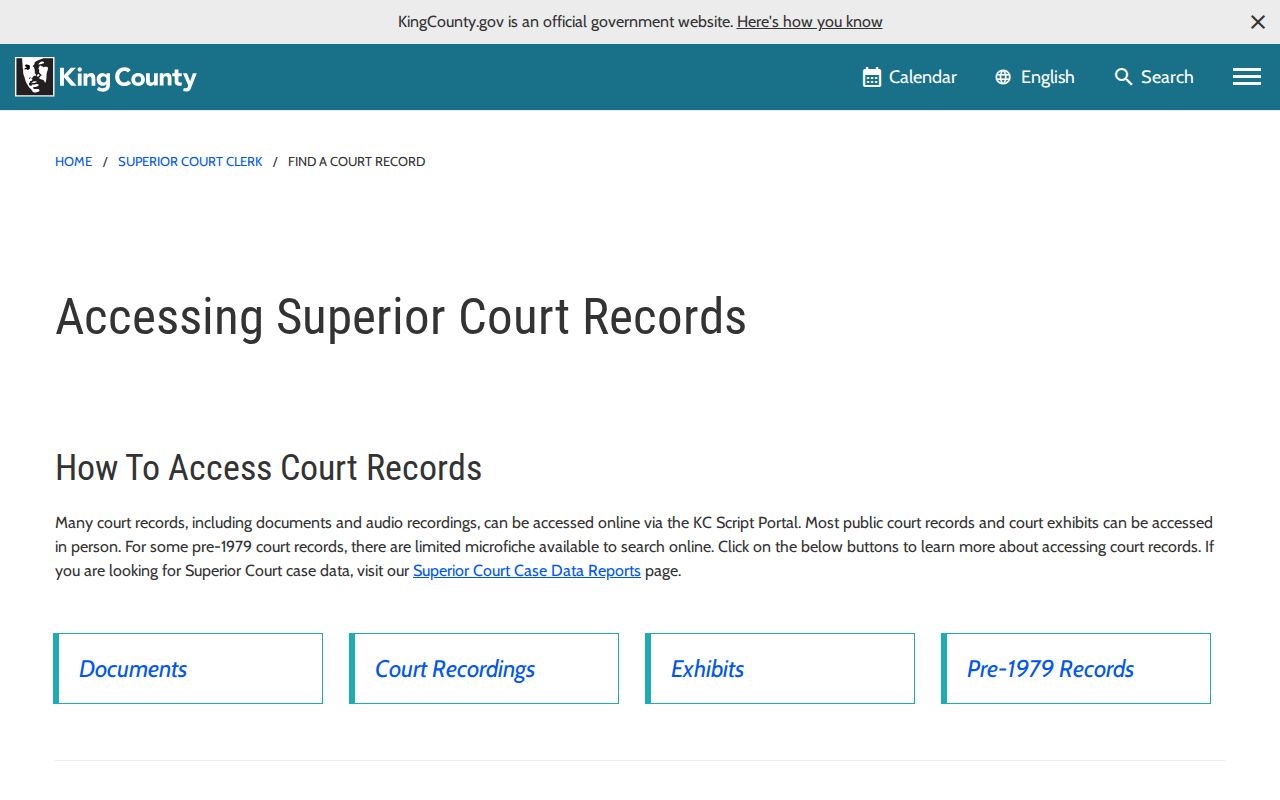
The captured source confirms that the clerk portal, public terminals, and direct file request are distinct channels. Court case files follow GR 31, while administrative judicial files use GR 31.1 rather than the ordinary PRA alone.
SeaTac Vital Record Access
Public Health Seattle and King County issues Washington births registered from 1907 forward and King County death records. The Washington Department of Health keeps statewide birth and death files plus marriage and divorce certificates from 1968 forward. The Recorder supplies a certified King County marriage record after recording, while a divorce decree comes from Superior Court. A DOH divorce certificate is only an abstract of the event.
Chapter 70.58A RCW limits certified birth and death products to qualified applicants with identity and relationship proof. Anyone may order a noncertified informational birth copy, so the claim that every birth record stays closed for 100 years is too broad. The $25 base applies to state vital products, and vendor or channel charges may be added. Birth and fetal-death records transfer to archives after 100 years; deaths, marriages, and divorces transfer after 25 years.
- Index
- A finding aid that points to a filed record; it may not include the image.
- Certified copy
- An official copy authenticated by the keeper for legal use.
- Custodian
- The agency or court responsible for holding and releasing a record.
- Exemption
- A statute or rule that permits specific facts or files to be withheld.
SeaTac Custody Record Channels
King County and Washington maintain separate custody lookups. The King County Subject Lookup Tool is the local route for booking and custody information. Its SeaTac public records search screen provides the county-level starting point.
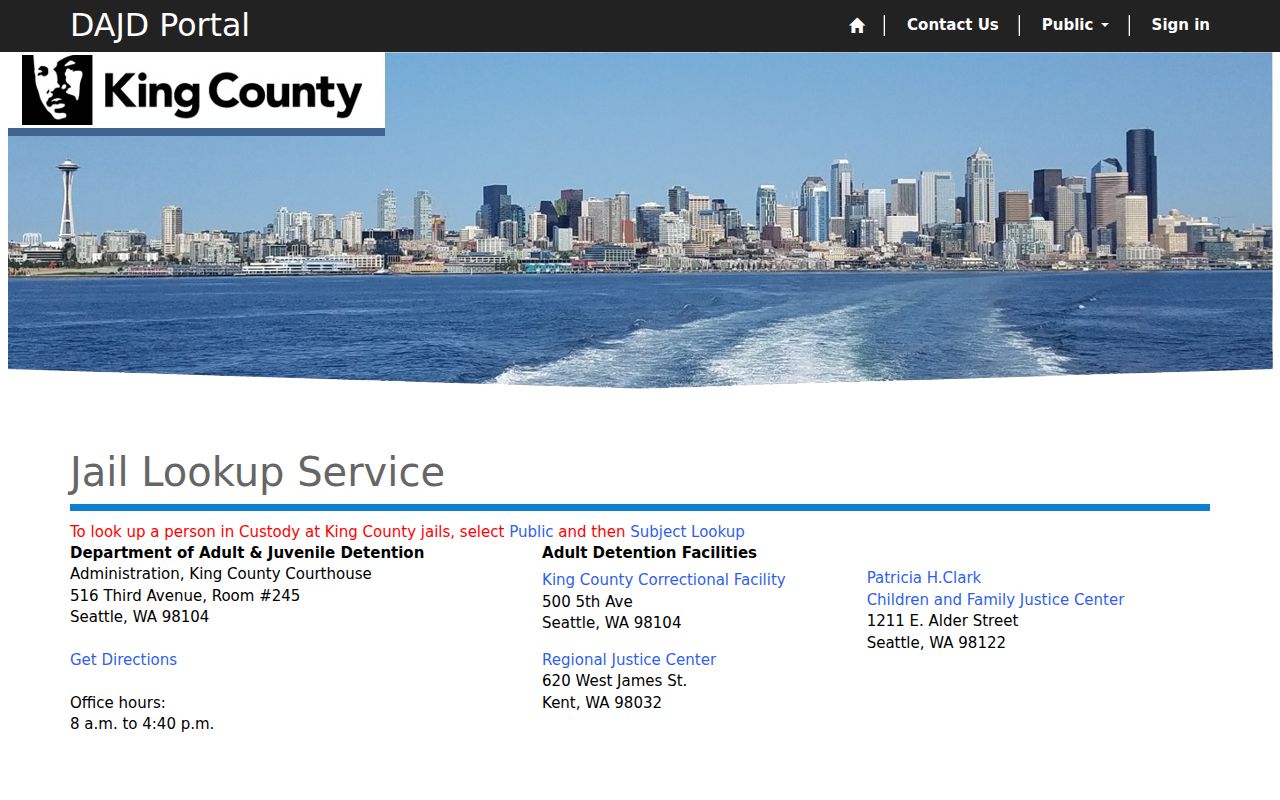
A county booking entry is not proof of conviction. Preserve the status and date, then check the proper court docket if legal outcome matters.
For state prison custody, use the Washington DOC Incarcerated Search. It accepts a name or DOC number and returns selected identity and current-facility facts.
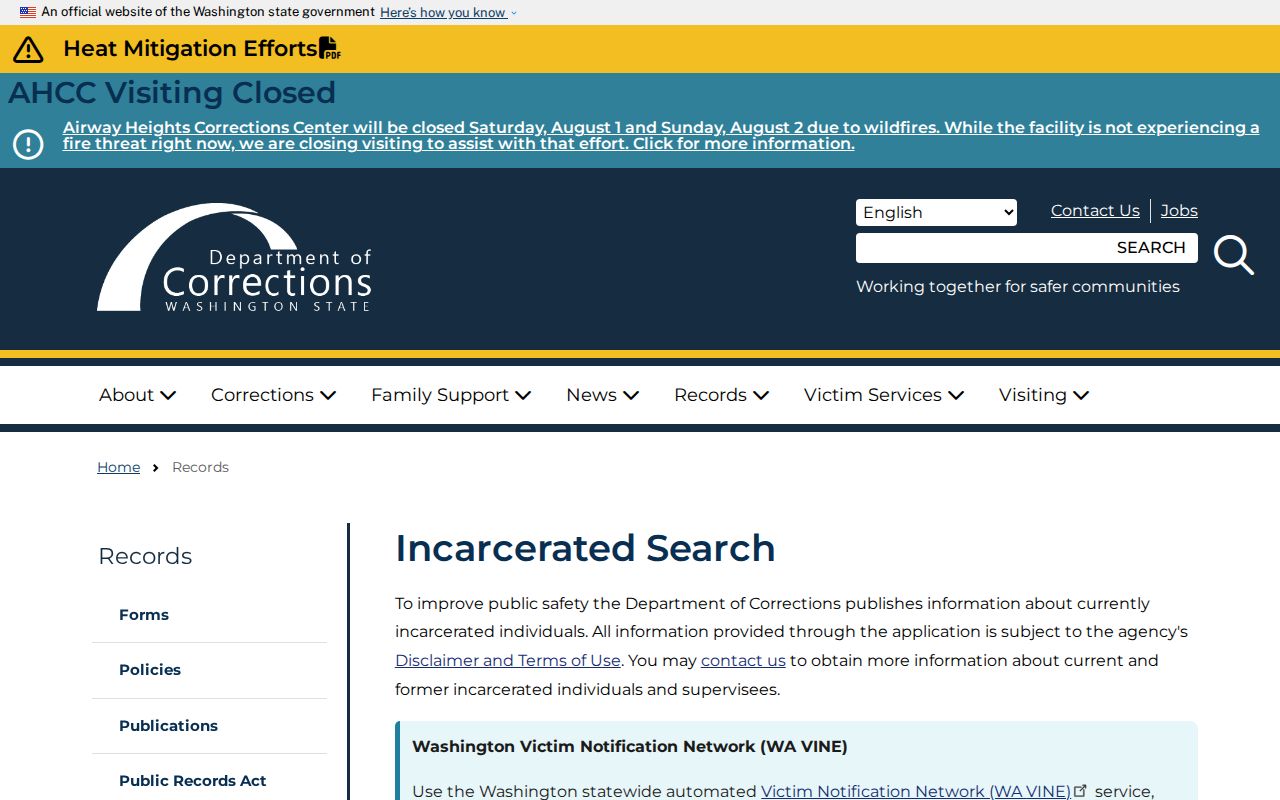
The state screenshot shows why DOC is a separate channel from the county jail tool. A missing result can reflect jurisdiction, release, or field limits and should not be treated as a finding about a person's full history.
SeaTac Business Filing Records
The Washington Corporations and Charities Filing System searches corporations, limited liability companies, nonprofits, and charities. A result can include an entity name, UBI, status, formation or registration date, registered agent, addresses, governors or officers when filed, and filing history. A registered agent accepts official papers; that role does not prove the person owns the entity.
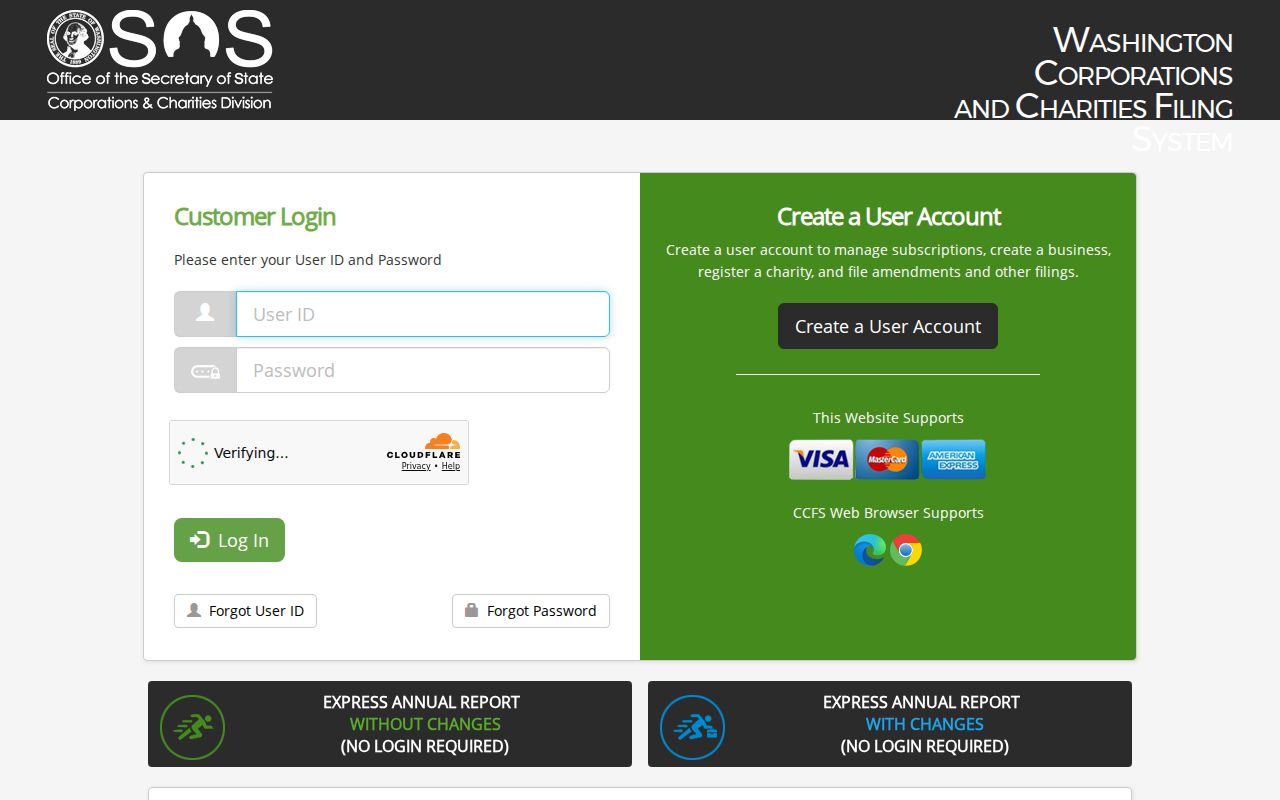
The filing-search view is useful for checking a seller's stated business identity. DOR Business Lookup may add trade names and city endorsements, while the Department of Licensing lookup covers regulated licenses by name, number, type, or location. These are separate public records systems, so compare identifiers rather than assuming a similar business name is the same organization.
SeaTac Public Records Custodians
The correct office depends on the act that created the record. City Hall handles SeaTac agency work. County offices handle land, assessment, many courts, health, and jail files. The Recorder supports online, phone, mail, and counter ordering; its counter is open weekdays from 8:30 a.m. to 4:30 p.m., with recording ending at 3:30 p.m. Phone ordering runs weekdays from 9 a.m. to 2 p.m.
King County Recorder
201 S Jackson St, Suite 204, Seattle, WA 98104
206-477-6620
SeaTac Records Fees and Timing
Inspection under the Washington Public Records Act is generally free. RCW 42.56.120 allows actual cost or a default schedule: 15 cents per printed page, 10 cents per scanned page, 5 cents per four electronic files or attachments uploaded, and 10 cents per gigabyte sent. Media and postage can be charged at cost. An agency may use a $2 flat fee when its estimate meets the statutory condition, and it may require deposits or installments.
Those rates do not replace special product fees. Vital certificates start at $25. Recorder copy and certification charges follow its schedule. Courts charge for documents or certification under the relevant clerk rules. Free viewing is also different from free certification. Ask for electronic inspection and a cost estimate if the record is large, then narrow the date range or file type before copies are made.
Note: The PRA's five-business-day rule sets the first response deadline, not a promise that every SeaTac request will be completed in five days.
Private Facts in SeaTac Records
The Address Confidentiality Program under chapter 40.24 RCW gives eligible survivors and certain threatened public-service groups a substitute address and mail forwarding. When a participant requests it, agencies generally use that substitute in a new public record. The real home, work, or school location and facts that reveal it are protected. Participation does not automatically erase an address released before enrollment.
Other limits follow the record. Full voter birth dates, signatures, credential numbers, and future-voter details stay confidential. Driver information is governed by federal and state restrictions. Sensitive numbers can be redacted from recorded copies, and access to military discharge papers is restricted. A lawful source does not grant leave to harass, impersonate, expose, or threaten anyone.
Request SeaTac Public Records
Any person may request identifiable state or local agency records under chapter 42.56 RCW, with no Washington residency rule. For a city file, SeaTac's NextRequest channel keeps messages and downloads together. The agency has five business days to produce the record, acknowledge the request with an estimate, seek clarification, or deny it with reasons. It need not answer questions, create a new report, or open an unrestricted system.
- Name the agency that created the file. Send city permits to SeaTac, deeds to the Recorder, and case documents to the filing court.
- Check the official index first. Capture a permit, parcel, recording, or case number when one appears.
- Describe an existing record with names, spelling variants, record type, address, and a narrow date span. Ask for native electronic files or inspection.
- Request a fee estimate. If the agency seeks clarification, narrow the scope without dropping the key identifier.
- Review redactions and the exemption cited. Seek available administrative review or judicial review under RCW 42.56.550 when warranted.
Lawful personal use. Open access supports family history, estate work, consumer verification, and civic oversight. Never use a record to stalk, harass, intimidate, impersonate, or harm a person.