
SeaTac People Directory Landscape
There is no official master list of everyone who lives in SeaTac. Instead, official and library directories sort people by a public role, a recorded act, an assessed parcel, a credential, or a point in history. Current government lists are good for reaching a public service. Land and license systems are better for tying a name to a formal record. Archives and library tools reach people who lived in the airport area before SeaTac incorporated.
The coverage table makes those limits visible. A city staff result does not establish a home address. An assessor entry identifies the owner assessed for a parcel, not who lives there. Likewise, a recorded party may have sold, bought, released, or benefited from an interest without ever occupying the land.
| Directory source | People or roles listed | Keeper | Access route |
|---|---|---|---|
| City staff list | Personnel and service desks | City of SeaTac | Free alphabet and filter browse |
| County directory | Employees, groups, and services | King County | Free web search |
| Highline staff search | Published district and school staff | Highline Public Schools | Public directory; some details withheld |
| Landmark | Grantors, grantees, and recorded parties | King County Recorder | Online from 1976; Archives before 1976 |
| Property roll | Assessed parcel owners | King County Assessor | Free address or parcel search |
| License lookups | Regulated professionals and businesses | Washington regulators | Free official searches |
| Historical indexes | Past residents, relatives, and record parties | Archives and libraries | Web, reference request, or research visit |
Use the narrowest directory first. A department name can route a city question even when no employee name is known. An old street address calls for a reverse directory or parcel trail. A claimed public credential belongs in the regulator's own lookup.
SeaTac Government Directory Entries
The SeaTac staff directory offers All, number, and A through Z tabs, two filters, page controls, and columns for Staff, Title, Departments, Phone, and Email. It mixes named employees with functional desks. That matters because a service entry such as City Clerk may be a better route than searching for one staff member whose duties can change.
| Control or field | Kind | How it works |
|---|---|---|
| Alphabet | Browse tabs | All, #, and A through Z |
| Two dropdowns | Filters | The official static page did not expose their full option lists |
| Pagination | Page links | First, Previous, numbered pages, Next, and Last |
| Results | Display columns | Staff, title, department, work phone, and email link |
A sample named entry showed Sandra Hutchison, Police Administrative Assistant, Police, a work telephone number, and an email link. Service rows instead use a desk name. When no useful entry appears, call the department's main line or City Clerk at 206-973-4661. An identifiable city record can also be sought through the city's records channel, with the access-law details kept in the SeaTac public records resource.
King County covers the functions that do not belong to City Hall. The King County employee and service directory searches staff, groups, and services. A group result can show its parent unit, phone, fax, TTY, mail stop, location, web link, keywords, staff, and linked services.
The official King County directory capture below shows its search surface.
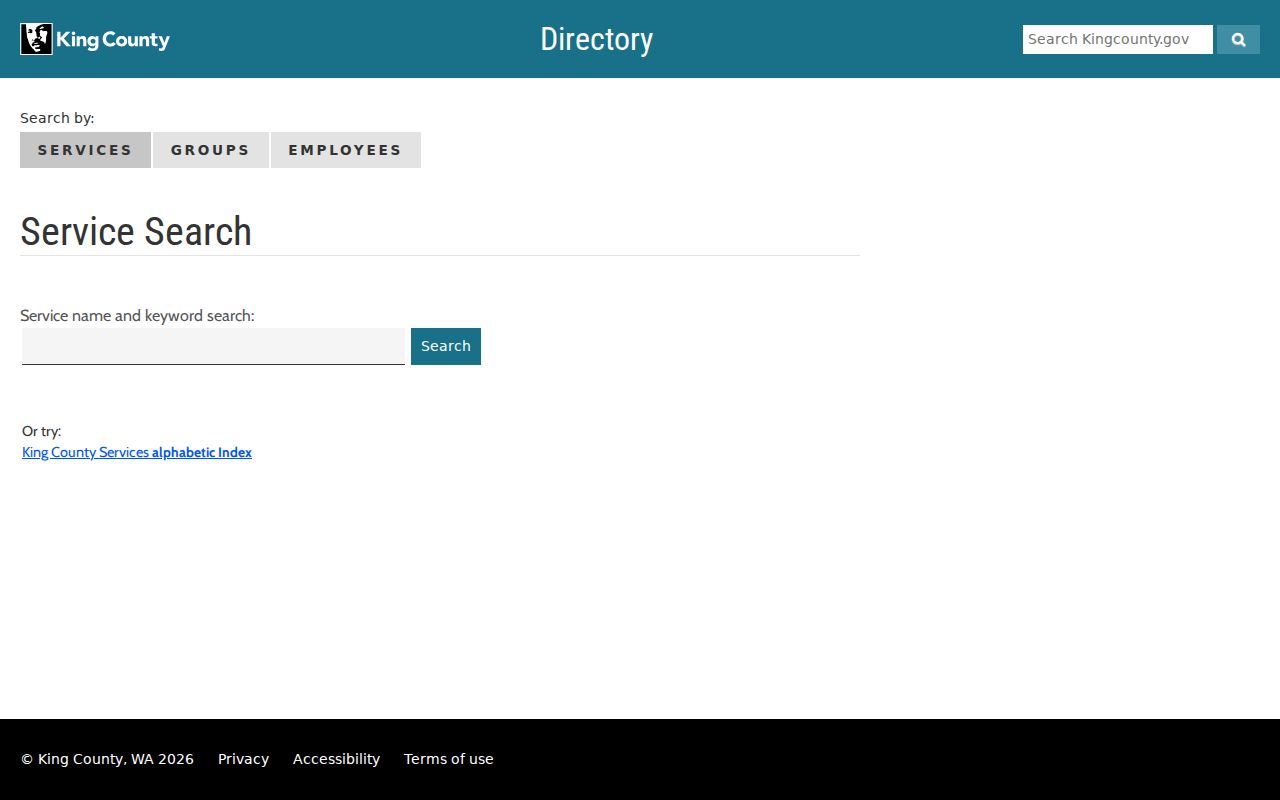
Those group and service results make it possible to reach the Recorder, Assessor, Elections, or another precise county unit without treating the list as a resident roll.
SeaTac School Directory Routes
Highline Public Schools is the main school district serving SeaTac. Its published staff directory can connect a name with a school, department, title, and public work contact when those fields are released. Some people or contact details may be left out for privacy and safety. Student records are not a public directory, so school staff search, public board minutes, yearbooks, and published historical collections must remain distinct.
A missing staff result is best handled through the school or district main office. Search both a person's name and the school or department. For a past classmate, identify the school from the address and year, then check yearbooks or school lists. A marriage index and later obituary can help follow a name change, but each source should be checked against dates and places before two entries are treated as one person.
Note: No verified local university or public SeaTac alumni directory was found, so an invented campus roster would give readers a false lead.
SeaTac Property Owner Directories
The King County Parcel Viewer and Assessor eReal Property work as address-first owner directories. Parcel Viewer accepts a street address, a ten-digit parcel number, or a map click. Its property link opens an assessor report with the assessed owner, site address, jurisdiction, legal description, land and building facts, assessed value, and sale history. Near SeaTac's borders, the jurisdiction field is especially useful because a postal label does not prove that the parcel lies inside the city.
Owner and occupant are not synonyms. The tax mailing address may belong to an owner elsewhere, a trust, a business, or an agent. A site address, sometimes called a situs address, is the physical parcel location. A parcel is the county's tax unit. These fields can connect a place to a recorded owner, but they do not establish who currently sleeps or receives personal mail there.
- Parcel
- A ten-digit King County tax identifier, separate from a Recorder instrument number.
- Situs address
- The physical address assigned to the land or building.
- Assessed owner
- The person or entity named on the assessment roll, not proof of occupancy.
- Legal description
- The land description that can survive a road or street-name change.
SeaTac Landmark Party Directory
The King County Landmark Records Search is a name directory of parties to recorded land and marriage documents. Its Name mode uses “Last, First.” Searchers can also choose document type, book and page, consideration, recording number, parcel ID, record date, legal description, or Torrens number. Trying short forms and spelling variants is wise because names and indexing practice changed over time.
Landmark's index begins in 1976. Entries from 1976 through July 31, 1991 generally give index facts without a document image; most images begin August 1, 1991. Parcel retrieval reaches 1997 onward, but parcel numbers were not indexed with good consistency until about 2002. For older material, King County Archives keeps general grantor and grantee microfilm indexes for 1853 through 1975 and recorded documents back to 1852.
A grantor transfers or releases an interest. A grantee receives or benefits from one. The directory entry can show the recording number, date, document type, names in those roles, parcel when indexed, legal description, and related reference. It is a transaction index, not a list of present residents.
Note: A missing image before 1991 usually points to Archives retrieval, not proof that the underlying record was destroyed.
SeaTac License Directory Searches
Washington divides professional and business directories by regulator. The Department of Licensing lookup searches a person or business by name, license number, license type, and location, then reports public status and expiration details. Health credentials belong to the Department of Health, contractors and trades to Labor and Industries, and lawyers to the Washington State Bar Association. One missing DOL result does not settle whether a credential exists.
The official DOL License Lookup capture shows its name, number, type, and place search choices.
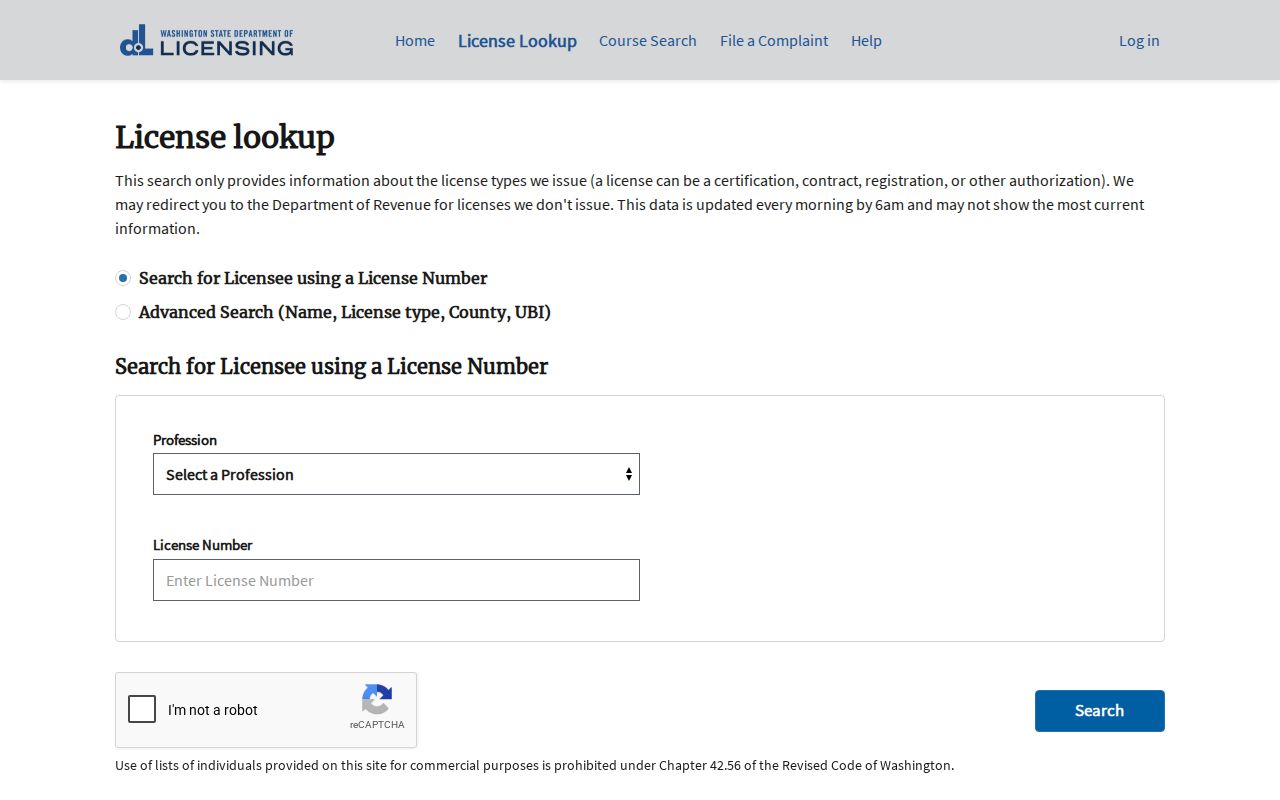
The form is useful for checking a public-facing credential, but the record's exact role and status still control its meaning. A location field may reflect a business address rather than a home.
Business names follow another split. Washington Department of Revenue Business Lookup covers active accounts plus five years of closed accounts and can surface owners, officers, trade names, addresses, and endorsements. The Secretary of State filing search shows entities, registered agents, governors, and filings. An agent is not automatically an owner. SeaTac's airport economy also makes Port records and federal aviation credentials useful in the right case, while a chamber list reflects voluntary membership rather than all local firms.
Historical SeaTac People Directories
SeaTac incorporated on February 28, 1990. Earlier people directories may classify residents under Angle Lake, Bow Lake, McMicken Heights, Riverton Heights, Sunnydale, Des Moines, Seattle, or unincorporated King County. The city name may be absent even when the address falls inside today's boundary. Airport expansion also changed roads and displaced parcels, so period place names, school districts, precincts, legal descriptions, and old street labels can be as important as a surname.
| Era | Directory trail |
|---|---|
| Before 1976 | Archives grantor/grantee microfilm, census, school, newspaper, and period directory sources |
| 1976 to July 1991 | Landmark index facts plus Archives for recorded images |
| August 1991 onward | Landmark index with most images, plus current parcel and agency lists |
| After 1990 | SeaTac city rosters join the older King County, Port, and school record layers |
King County's Auditor recorded county documents through 1969. The home-rule charter shifted recording work to the Recorder in 1970. That office history explains the labels researchers may see in older indexes; it does not signal a break in the whole deed series.
SeaTac Library Directory Help
The King County Library System genealogy service supplies database instruction, obituary requests, and referrals to regional archives. Valley View Library is SeaTac's local branch. Auburn Library holds a South King County Genealogical Society collection and scheduled volunteer help. KCLS also points researchers to the Puget Sound Regional Branch for territorial census, vital, school-district, voter, property, and other local government series.
The official KCLS services page capture highlights genealogy holdings, obituary help, and research referrals.
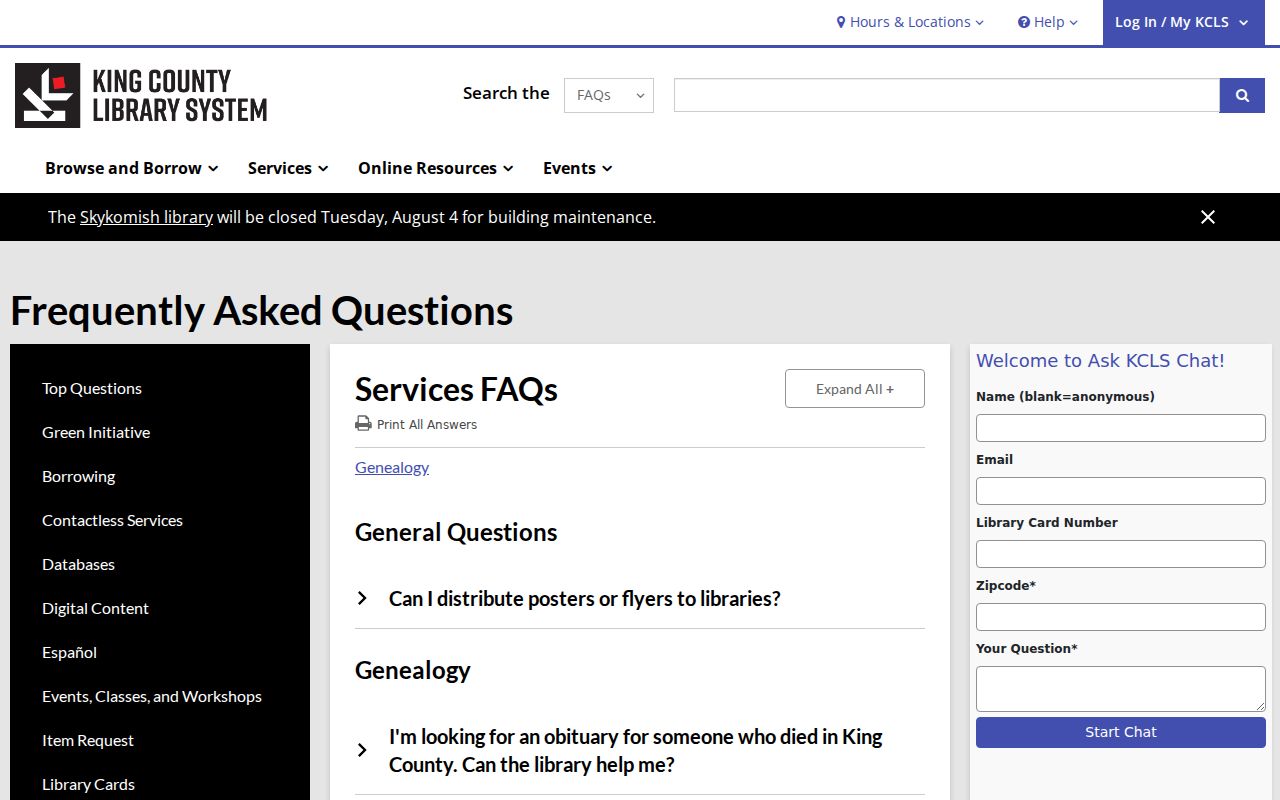
For an obituary request, give the full name, death date, and likely KCLS-served community. Staff search from the death date through the next ten days and usually answer within 14 working days. No obituary is guaranteed because publication was never required.
No official KCLS page in the research sweep gave exact SeaTac-area Polk, telephone, or reverse-directory titles and years. Ask reference staff or search the catalog by title and year using “Seattle city directory,” “R. L. Polk,” “telephone directory,” “Cole directory,” and “criss-cross.” A reverse directory changes the direction of the search: it starts with an address and returns the listed occupant at that time.
SeaTac Digital Archive Directories
The Washington State Digital Archives brings many historical name indexes into one official search. Controls vary by collection but may include county, first, middle, and last name, date or year, and keywords. Results can contain event date and place, record number, relatives, witnesses, and an image or copy route. Marriage, birth and death, naturalization, census, court, institution, voter, and local-government series each have their own coverage, so the collection page must be read before a gap is treated as evidence.
Search neighboring labels and name variants. SeaTac did not exist as a municipal index term before 1990, and the area's immigrant and refugee communities make transliteration, multi-part surnames, spacing changes, and reversed name order real search issues. Match a directory hit to a date, address, relative, or document role before joining records.
SeaTac Civic Directory Clues
City council, board, and commission rosters identify elected or appointed people and their public service periods. Meeting minutes can add an organization, neighborhood, project, or date that separates people with the same name. Port of Seattle commission records are unusually important here because airport leases, contracts, acquisitions, and public meetings create a parallel set of names outside City Hall.
Highline yearbooks, historical school records, newspapers, cemetery indexes, and funeral-home obituary archives cover different groups. They are not interchangeable. A yearbook supports school and year evidence; an obituary may supply relatives and a married name; a cemetery transcription may point to burial. Confirm key dates through an official index or original record when possible.
- Fix the likely year and the period place name.
- Choose the roster that could have listed that role or household.
- Try spelling, name-order, and nearby-community variants.
- Record the source's coverage date and what the listed role means.
- Confirm the match with a second date, place, relative, or formal record.
These layers explain why no single SeaTac resident directory can be complete. The reliable path is a set of limited official and historical directories, each used for the population and time it was built to describe.